About

AZ-ASCEND is an Arizona-based Antimicrobial Stewardship Protocol (ASP) that uses standardized infection definitions to guide culturing and prescribing practices, administrative engagement, staff education, and regular data feedback.

Antimicrobial Resistance

An Emerging Crisis & Call to Action

Antimicrobial resistance is driven by selective microbial pressure from high rates of antibiotic prescribing. Within long-term care Skilled Nursing Facilities (SNFs) 47% to 79% of residents are prescribed at least one antibiotic annually.(1) However, prescribing is often unjustified; nearly half of all antibiotics prescribed are estimated to be inappropriate.(2) Today, an estimated 35% of all nursing home residents are colonized with multi-drug resistant organisms.(3)

Prescribing rates within SNFs is further amplified by entrenched prescriber preferences and complex underlying cultural pressure from patients and their families.(4,5) Importantly, antibiotics are not uniformly helpful and have been shown to directly increase the number of adverse events for SNF residents.(2) Prescribing is not isolated to these residents, and may further expose other residents – and the community at large – to resistant bacterial strains.(6)

Antimicrobial Stewardship Programs (ASPs) may reduce antimicrobial prescribing in SNFs.(7) The Centers for Medicaid Services (CMS) updated the Requirements for Participation for Skilled Nursing Facilities to implement a SNF.(8) Fulfilling CMS requirements to implement ASPs in Arizona’s nursing homes have been impeded by local challenges such as variable administrative structures, inadequate tools for guiding antibiotic prescribing practices, and the need for inter-facility collaboration. Due to the variability of resource-related factors among LTCs, interventions must implement interventions addressing multiple barriers to inappropriate antibiotic use to limit unnecessary prescribing.  

Program background & development

How is AZ-ASCEND different from other ASPs?

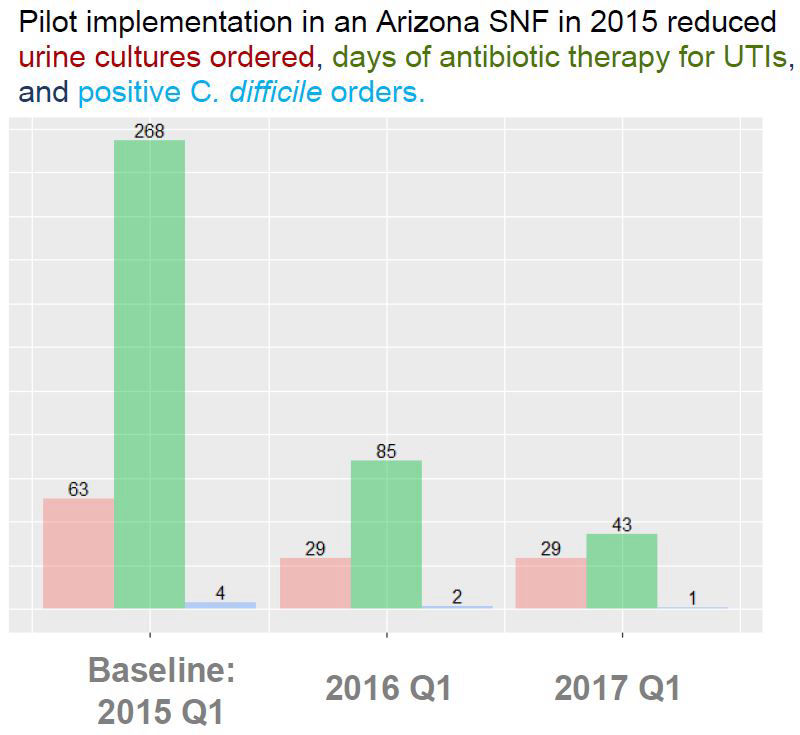
AZ-ASCEND is an Arizona-based Antimicrobial Stewardship Protocol (ASP) based on a pilot study, previous qualitative findings from interviews with skilled nursing facility staff, and components from other successful stewardship materials. In 2015 several Arizona-based nursing homes piloted a program to reduce antibiotic use for suspected urinary tract infections (UTI). Over the course of two years, this program demonstrated a 54% reduction in total urine culturing and an 84% decrease in total days of antibiotic therapy, with no report of urosepsis events.(9)

Mobirise

Our pilot study is based on an antibiotic stewardship template initially developed by AMDA – The Society for Post-Acute and Long-Term Care Medicine.(10) ASP components were referenced against tools initially developed by the Agency for Healthcare Research and Quality (AHRQ) and the Centers for Disease Control and Prevention (CDC) Core Elements of antimicrobial stewardship for Nursing Homes.(11,12) Trainings and data feedback processes emphasize facility-wide engagement as recommended by AHRQ toolkits.(11) Trainings were in part based on program elements using qualitative evidence captured from semi-structured interviews with clinicians, and non-clinical staff at 10 Arizona SNFs.(13)

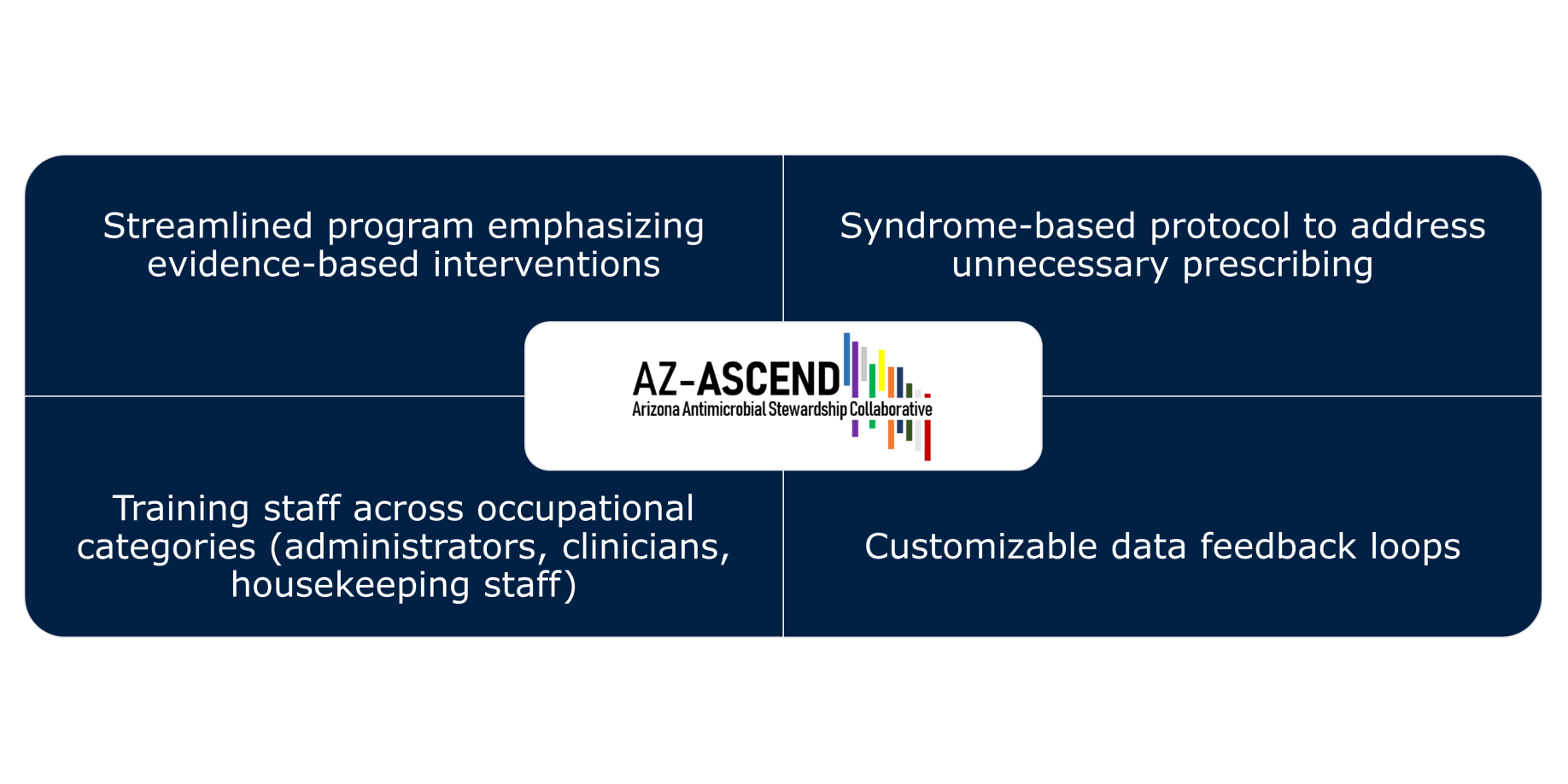
Our protocol makes several distinctions from previously developed ASPs, which while robust, may be time-consuming and cumbersome for LTCFs to navigate. We emphasize ASP components previously shown to be successful in stemming inappropriate prescribing including simultaneous delivery of training and data feedback.(14) Data feedback reports are desgined to be shared on a quarterly basis to account for prescriber resistance to modifying antibiotic usage if audit data is perceived as low quality.(15) See our key components:

Mobirise

Key components of AZ-ASCEND

AZ-ASCEND

How does this protocol work?

AZ-ASCEND (The Arizona Antibiotic Stewardship Collaborative to Enhance Nursing Home Decisions) is implemented via three phases: 1) engagement with a multidisciplinary team, 2) training and education on effective antimicrobial usage, and 3) data feedback interventions to isolate and target tangible areas for improvement.

  • Engagement. Evidence indicates that the decision to prescribe is often made off-site and is influenced by inter-professional communication.(2) Our protocol emphasizes engagement and formal commitment by the senior leadership within a facility, which at minimum includes the Executive Director, Medical Director, Director of Nursing, and Pharmacist, if applicable within a facility.(17) Subsequent trainings and data reports are distributed to all staff to promote facility-wide engagement.
  • Clinical Training. Staff are educated on appropriate antibiotic usage through a series of clinical trainings. Trainings emphasize the de-escalation of antibiotics, dubbed the “antibiotic timeout”, to avoid unnecessarily long courses and broad-spectrum regimens.(18) Trainings were designed inclusively for both prescribing practitioners and other staff.(19) Quarterly reports are referenced during training to identify areas for improvement as recommended by CMS.(20)
  • Data Tracking & Feedback. We developed a procedure to quantify inappropriate antibiotic prescribing using the McGeer criteria.(21) Data are collected by an Infection Preventionist or equivalent staff and incorporated into previously designed reports. Suspected infections and prescribed antibiotics – including total days of therapy, dosage, and antibiotic starts – are captured on a monthly basis. Rates of C. difficile and ESBL producing isolates are captured as outlined by the CMS State Operations Manual.
Ready to get started?
Get oriented using our implementation sequence:
Mobirise

References

1. van Buul LW, van der Steen JT, Veenhuizen RB, Achterberg WP, Schellevis FG, Essink RT, et al. Antibiotic use and resistance in long term care facilities. J Am Med Dir Assoc. 2012;13(6):568. e1-568. e13.
2. Crnich CJ, Jump R, Trautner B, Sloane PD, Mody L. Optimizing Antibiotic Stewardship in Nursing Homes: A Narrative Review and Recommendations for Improvement. Drugs Aging. 2015 Sep 1;32(9):699–716.
3. Cassone M, Mody L. Colonization with Multidrug-Resistant Organisms in Nursing Homes: Scope, Importance, and Management. Curr Geriatr Rep. 2015 Mar 1;4(1):87–95.
4. Daneman N, Gruneir A, Bronskill SE, Newman A, Fischer HD, Rochon PA, et al. Prolonged antibiotic treatment in long-term care: role of the prescriber. JAMA Intern Med. 2013;173(8):673–82.
5. Fleming A, Bradley C, Cullinan S, Byrne S. Antibiotic Prescribing in Long-Term Care Facilities: A Meta-synthesis of Qualitative Research. Drugs Aging. 2015;32(4):295–303.
6. Daneman N, Bronskill SE, Gruneir A, Newman AM, Fischer HD, Rochon PA, et al. Variability in antibiotic use across nursing homes and the risk of antibiotic-related adverse outcomes for individual residents. JAMA Intern Med. 2015;175(8):1331–9.
7. Wu JH-C, Langford BJ, Daneman N, Friedrich JO, Garber G. Antimicrobial Stewardship Programs in Long-Term Care Settings: A Meta-Analysis and Systematic Review. J Am Geriatr Soc. 2019 Feb;67(2):392–9.
8. Barlam TF, Cosgrove SE, Abbo LM, Macdougall C, Schuetz AN, Septimus EJ, et al. Implementing an antibiotic stewardship program: Guidelines by the Infectious Diseases Society of America and the Society for Healthcare Epidemiology of America. Clin Infect Dis. 2016;62(10):e51–77.
9. Patterson PP, Ellingson KD, Backus D, Schmitz E, Matesan M. A syndrome-based approach to antimicrobial stewardship in an Arizona skilled nursing facility-Moving the needle through quality improvement. Am J Infect Control. 2020 Dec;48(12):1537–9.
10. Jump RLP, Gaur S, Katz MJ, Crnich CJ, Dumyati G, Ashraf MS, et al. Template for an Antibiotic Stewardship Policy for Post-Acute and Long-Term Care Settings. J Am Med Dir Assoc. 2017 Nov 1;18(11):913–20.
11. Toolkits | Agency for Healthcare Research and Quality [Internet]. [cited 2021 Feb 24]. Available from: https://www.ahrq.gov/nhguide/toolkits.html
12. The Core Elements of Antibiotic Stewardship for Nursing Homes. :21.
13. LeGros T, Kelley C, Ellingson K. Barriers and Facilitators to Antibiotic Stewardship at Skilled Nursing Facilities Suggest a Systems Approach. Unpubl Manuscr. 2021;
14. Naughton BJ, Mylotte JM, Ramadan F, Karuza J, Priore RL. Antibiotic use, hospital admissions, and mortality before and after implementing guidelines for nursing home–acquired pneumonia. J Am Geriatr Soc. 2001;49(8):1020–4.
15. Szymczak JE, Feemster KA, Zaoutis TE, Gerber JS. Pediatrician Perceptions of an Outpatient Antimicrobial Stewardship Intervention. Infect Control Hosp Epidemiol. 2014 Oct;35(S3):S69–78.
16. Langford BJ, So M, Raybardhan S, Leung V, Soucy J-PR, Westwood D, et al. Antibiotic prescribing in patients with COVID-19: rapid review and meta-analysis. Clin Microbiol Infect [Internet]. 2021 Jan 5 [cited 2021 Feb 11]; Available from: https://www.sciencedirect.com/science/article/pii/S1198743X20307783
17. Rantz MJ, Zwygart-Stauffacher M, Flesner M, Hicks L, Mehr D, Russell T, et al. The Influence of Teams to Sustain Quality Improvement in Nursing Homes that “Need Improvement.” J Am Med Dir Assoc. 2013 Jan;14(1):48–52.
18. Bassetti M, Paiva J-A, Masterton RG. The case for de-escalation in antimicrobial therapy: time to change our strategy in the management of septic shock? Intensive Care Med. 2014 Feb;40(2):284–5.
19. Katz MJ, Gurses AP, Tamma PD, Cosgrove SE, Miller MA, Jump RLP. Implementing Antimicrobial Stewardship in Long-term Care Settings: An Integrative Review Using a Human Factors Approach. Clin Infect Dis Off Publ Infect Dis Soc Am. 2017 Dec 1;65(11):1943–51.
20.  Centers for Medicaid Services. Available from: https://www.cms.gov/Regulations-and-Guidance/Guidance/Manuals/Internet-Only-Manuals-IOMs-Items/CMS1201984
21. Stone ND, Ashraf MS, Calder J, Crnich CJ, Crossley K, Drinka PJ, et al. Surveillance Definitions of Infections in Long-Term Care Facilities: Revisiting the McGeer Criteria. Infect Control Hosp Epidemiol Off J Soc Hosp Epidemiol Am. 2012 Oct;33(10):965–77.  
Address

1295 N Martin Ave,
Tucson, AZ 85724


Contact

Ferris Ramadan, Coordinator
Email: ferrisr@arizona.edu 
Phone: +1 (520) 626-7914

Quick Links
Feedback

Please send us your ideas, bug reports, suggestions. Any feedback would be appreciated.

The website was started with Mobirise