AZ-ASCEND

Arizona Antimicrobial Stewardship Collaborative

AZ-ASCEND is a grant-funded collaborative that takes a results-oriented approach to antibiotic stewardship. A community physician coach trains staff at participating facilities and Epidemiologists at The University of Arizona work to streamline monitoring and feedback of data for action.

What is AZ-ASCEND?

AZ-ASCEND is an Arizona-based Antimicrobial Stewardship Protocol (ASP) that uses standardized infection definitions to guide culturing and prescribing practices, administrative engagement, staff education, and regular data feedback. We use successful stewardship elements from our pilot ASP, scientific literature, and federal guidelines to develop a standardized implementation sequence.

Our protocol to implement an antibiotic stewardship in LTCs builds on a local evidence-based program and federally endorsed materials to meet CMS requirements. We have developed a series of training resources that target multiple organizational staff and provide explicit guidance for enrollment, data collection training, education, and feedback loops. Components within our protocol are critical for broad organizational engagement internal LTC incentivization to reduce unnecessary prescribing.

Click on the links below to download key program materials, including presentation templates, videos, and reporting tools to replicate AZ-ASCEND in your Long-Term Care setting. If this is the first time accessing these resources, please visit our implementation sequence to learn how to get started:

Implementation

A training schedule with presentations and implementation sequence to reduce inappropriate prescribing.

Materials

Compiled resources used to promote engagement in ASP activities, track activities, and capture data used for feedback.
 

Videos

Prerecorded trainings and downloadable presentations led by Dr. Pete Patterson 

Reporting

Templates and R+Rmarkdown code to generate reports for data feedback on prescribing trends.

Background

Skilled nursing facility residents are at heightened risk for acquisition of antibiotic-resistant bacteria due to declining immune function, frequent healthcare contacts, institutional living, and selective antibiotic pressure. Suspected urinary tract infection (UTI), based on altered mental status and bacteriuria, with no other urinary symptoms, is the most common reason for antibiotic prescription in SNFs, although there is no evidence that antibiotic treatment improves outcomes in older adults with these syndromes.

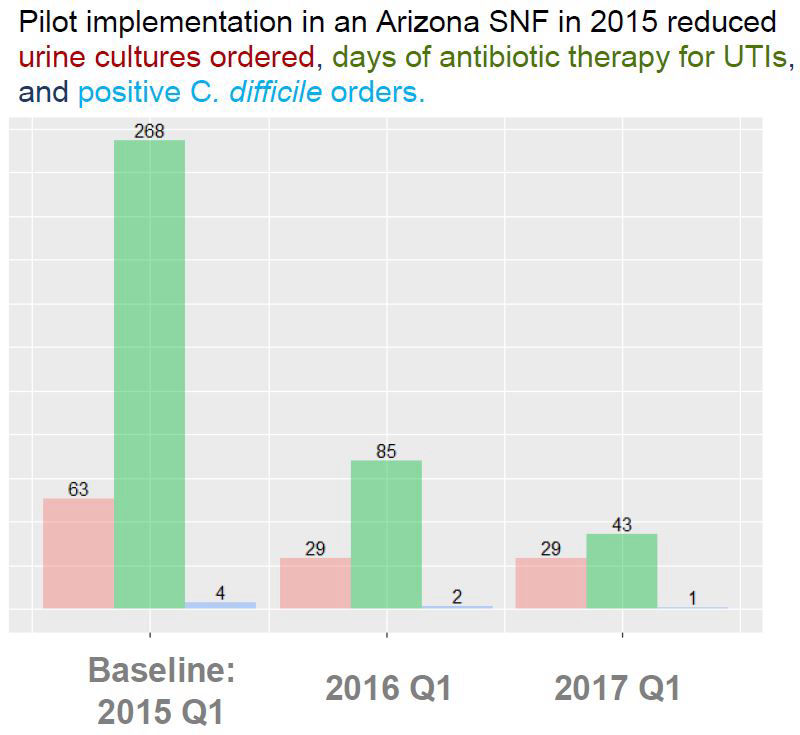
Our overall objective is to improve the appropriateness of antibiotic prescribing through evidence-based ASP implementation. Our central hypothesis is that SNFs can reduce unnecessary antibiotic prescribing – and antibiotic-associated adverse events – through implementation of protocols that emphasize the use of standardized infection definitions to guide culturing and prescribing practices, administrative engagement, staff education, and consistent data feedback. Our preliminary data suggest that antibiotic use and C. difficile infections can reduced by at least 50% in SNFs with implementation of a simple protocol focused on prescribing for suspect urinary tract infections (UTIs). Learn more about this protocol in our brief report A syndrome-based approach to antimicrobial stewardship in an Arizona skilled nursing facility—Moving the needle through quality improvement

Mobirise
Address

1295 N Martin Ave,
Tucson, AZ 85724


Contact

Ferris Ramadan, Coordinator
Email: ferrisr@arizona.edu 
Phone: +1 (520) 626-7914

Quick Links
Feedback

Please send us your ideas, bug reports, suggestions. Any feedback would be appreciated.

Mobirise web software - Visit site